
The Battle Of The Bleeding Pits
The information board at the ruin of St John’s Church, Gamrie, tells the story of The Bloody Pits, a battle between Scots and "Vikings" in 1004 C.E.
That is an abridged version of the account given by Rev. Thomas Wilson in the 1832 edition of The Aberdeen Magazine, and later in the entry for Gamrie in the 1845 New Statistical Account.
A Danish fleet lands in the area of Gamrie. On the opposite side of the valley, Scots on Castle Hill, observe the landing, but are too few in number to attack the Danes. Signal beacons are lit and reinforcements begin to arrive.
The Danes meanwhile have set up camp where St Johns Church now stands.
The Thane of Buchan, leader of the Scots, prays to St John for his assistance in defeating the Danes and pledges to build a church where the Danes are camped.
Part of the Scottish army moves round the head of the valley to west of the enemy camp and occupy higher ground overlooking the Danes. They then start to push boulders down on to enemy below.
The Danes are driven from their camp, which the Scots occupy and stop to build a church.
The Danes escape by the north east brow of the hill to form a new camp, where their entrenchments can still be seen.
The new camp allows them communication with the shore and the top of the hill.
From the 'Auld Haven", a bay some 4 miles to the west a further force of Danes comes to join their countrymen and the Scots are driven back to their position on the castle hill.
The Danes retake their camp and use the newly built church as a stable for their horses.
With more reinforcements the Scots force the Danes back to their previous position, and gain the heights. Once, again the Scots start rolling boulders onto the Danes and then rush down to attack, where the Danes are slaughtered.
Their bodies are thrown in hollows, leading then place being called The Bloody Pits.
A church dedicated to St John is built and the skulls of 3 Danish chieftains are placed in niches in the walls inside the church.
Leading to the nickname of the Church of Sculls.
In his 1832 Aberdeen Magazine article the Rev. Thomas Wilson says that the skulls can be seen to his day. In the later version for the New Statistical Account, he says that the church having been abandoned for about 12 years led to the skulls being taken bit by bit, by tourists. One skull was a recovered and given to the "Museum of Lit. Inst. Banff"
The three sites mentioned in the 1832 account
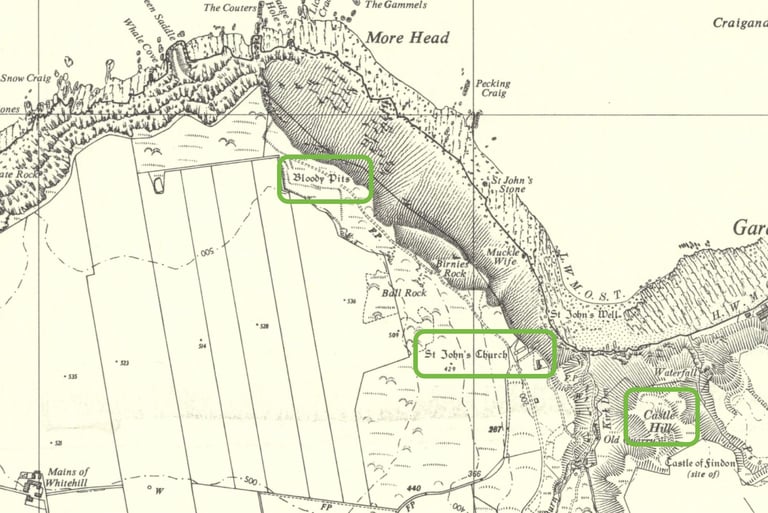
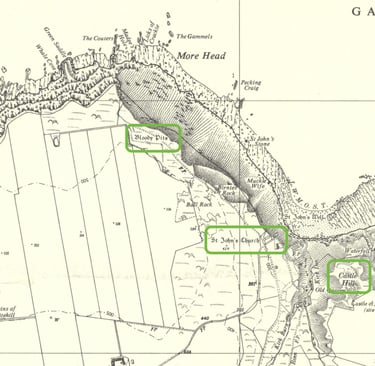
Ordnance Survey National Grid Maps NJ76SE & part of NJ76NE - A
Surveyed/Revised Pre-1930 to 1958. Published 1959
Reproduced with the permission of the National Library of Scotland (CC-BY (NLS))
An earlier and very much briefer account is given by the Rev. M Wilson in the Statistical Account Vol. I of 1791. Significantly Rev. M Wilson says that the tradition is that battle happened sometime before 1004, and the Thane of Buchan pursued the Dates to the precipice above the church, where they were defeated.
The church was said to have been built in 1004, with that date still visible above the fireplace.
Rev. M Wilson states that several of the Danish skulls were built into the church wall, where they remain, leading it be called by some the Kirk of Sculls.
On land above the church, on a flat plain are the remains of encampments called bloody pots or bloody pits.
Rev. Lachlan Shaw's History of The Province of Moray from 1775, wrote a detailed account of the bAttle of Mortlach in 1010 and following Malcolm II's victory notes that, following defeats at Balbryde, Aberlemno, Gemrie, and Cruden, the Danes left the kingdom (of Scotland) by 1012 CE. This appears to be the earliest record of the battle at Gamrie.
A map by James Robertson, printed in 1822 indicates where the Bloody Pitts Camp was.
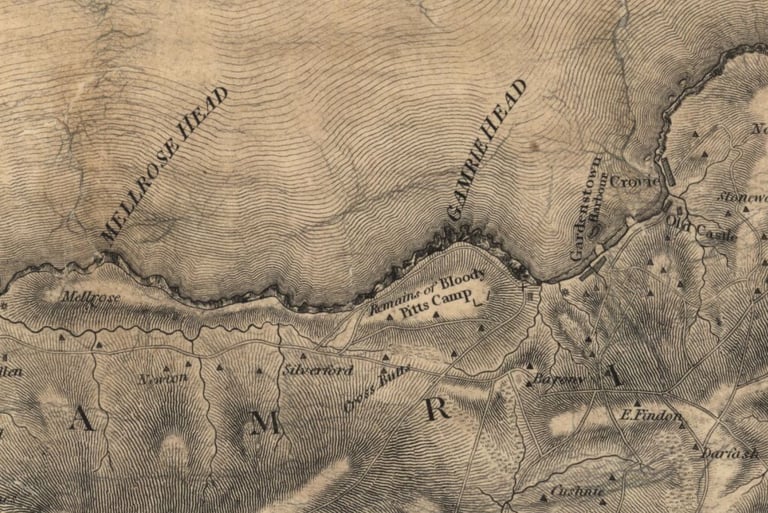
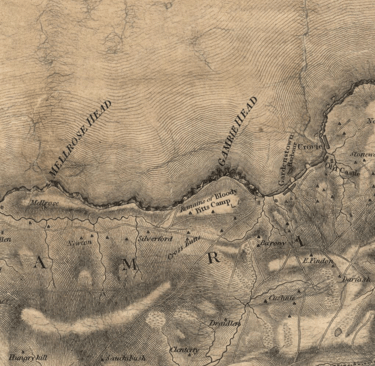
Robertson, James, Topographical & military map...Aberdeen, Banff & Kincardine., 1822
Reproduced with the permission of the National Library of Scotland (CC-BY (NLS))
Later accounts, such as that by W Barclay in his book “Banffshire”, published in 1922 only repeat elements of the account by Rev. Thomas Wilson.
Contact
contact@banffshirethings.uk
© 2026. All rights reserved.